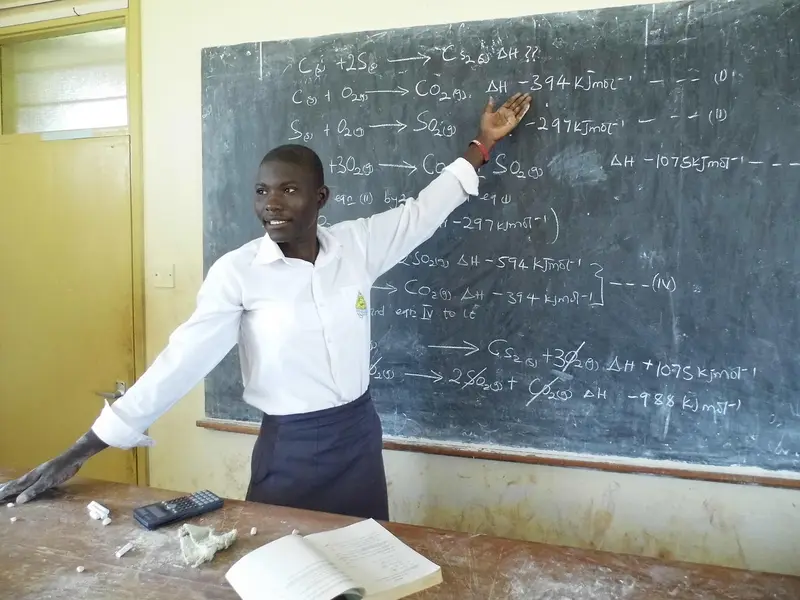
Moles. Equations. That practical where everyone else's solution turns pink and yours stays clear. If Chemistry makes your heart beat faster, and not in a good way, you're not alone. Lots of students wonder how to pass KCSE Chemistry when it feels this hard.
Relax. By the end of this read, you'll have a clear plan: what each paper tests, which topics unlock everything else, a simple method for mole calculations, and how to prepare for the practical.
Here's the short answer. Master the foundation topics first (the mole, equations, bonding, acids and salts), practise questions daily, and treat Paper 3 as a skill you train, not a test you hope for.
What does KCSE Chemistry look like?
KCSE Chemistry has three papers. According to KNEC's KCSE timetable (2024 KCSE timetable):
| Paper | Code | What it is | Time |
|---|---|---|---|
| Paper 1 | 233/1 | Theory: short-answer questions | 2 hours |
| Paper 2 | 233/2 | Theory: longer structured questions | 2 hours |
| Paper 3 | 233/3 | Practical | 2 hours 15 minutes |
You may use a specified non-programmable calculator in Chemistry, as the same timetable states.
Why Chemistry feels hard (and why it doesn't have to)
Chemistry is built like a staircase. If one step is missing, the next feels impossible. Students who "hate Chemistry" usually have one or two weak foundation topics that make everything after them confusing.
Fix those steps, and the rest starts making sense.
Which KCSE Chemistry topics matter most?
All of them can appear, but they aren't equal. Some topics are foundations: they show up inside other questions. Others are big standalone topics that carry whole questions on their own. Learn them in that order.
The foundation topics that unlock everything
Start here. These four come up again and again inside other topics:
- The mole and chemical equations. Almost every calculation in KCSE uses them.
- Atomic structure, the periodic table and bonding. They explain why elements behave the way they do.
- Acids, bases and salts. Central to both theory and the practical.
- Writing and balancing equations with state symbols: (s), (l), (g) and (aq). Examiners expect them.
The big standalone topics
Once the foundations are solid, move on to the larger Form 3 and 4 topics. For each one, here's what to focus on:
| Topic | Focus on |
|---|---|
| Organic chemistry | Naming compounds, homologous series, and which reaction turns one substance into another |
| Electrochemistry | Redox, the electrochemical series, and electrolysis calculations |
| Energy changes | Exothermic vs endothermic, energy level diagrams, and heat calculations |
| Reaction rates and equilibrium | What speeds up a reaction, and how conditions shift equilibrium |
| Metals and non-metals | Extraction, properties, uses, and the reactions of key compounds |
Ask your teacher which topics your class has covered and which are still coming, then slot them into your plan.
A simple method for mole calculations
Use the same four steps for every mole question:
- Write the balanced equation.
- Find moles of what you know (moles = mass ÷ molar mass, or moles = concentration × volume in dm³).
- Use the ratio from the equation to get moles of what you want.
- Convert to what the question asks: mass, volume or concentration.
Let's try it. How many grams of magnesium oxide form when 4.8 g of magnesium burns completely? (Mg = 24, O = 16)
- 2Mg(s) + O₂(g) → 2MgO(s)
- Moles of Mg = 4.8 ÷ 24 = 0.2 mol
- Ratio Mg : MgO = 2 : 2, so moles of MgO = 0.2 mol
- Molar mass of MgO = 24 + 16 = 40. Mass = 0.2 × 40 = 8.0 g
Show every step like this in the exam. Even if your final answer slips, the working can still earn marks.